
1. The Financial Anatomy of Thermal Gear: Why Decoding Cooler Bag Cost Protects Your Brand Margins
Accurately decoding cooler bag cost protects brand profit margins and prevents financial loss during soft-goods procurement. Emerging e-commerce brands often struggle because fluctuating raw material expenses and factory overheads catch teams off guard. Sourcing thermal luggage requires mastering unit economics to evaluate competitive pricing tiers. Understanding these financial dynamics allows brand owners to negotiate effectively with manufacturing partners. Raw material prices and factory overheads shift unpredictably across global supply chains. Brand buyers must analyze these volatile factors to prevent margin compression on established SKUs. Establishing predictable supplier agreements locks in production budgets and safeguards long-term financial stability. Sourcing alignment ensures factory quotations match target retail price points without compromising structural durability. Strategic managers collaborate directly with certified original equipment manufacturers to eliminate intermediary trading markups.
| Financial Element | Impact on Budget | Mitigation Strategy |
| Raw Material Volatility | Sudden margin compression | Lock in predictable long-term supplier agreements |
| Hidden Factory Overheads | Unexpected financial loss | Partner directly with certified OEM manufacturers |
| Intermediary Markups | Inflated landed manufacturing costs | Eliminate trading middlemen through direct sourcing |
2. Material Economics: Analyzing the Core Drivers of Cooler Bag Material Cost
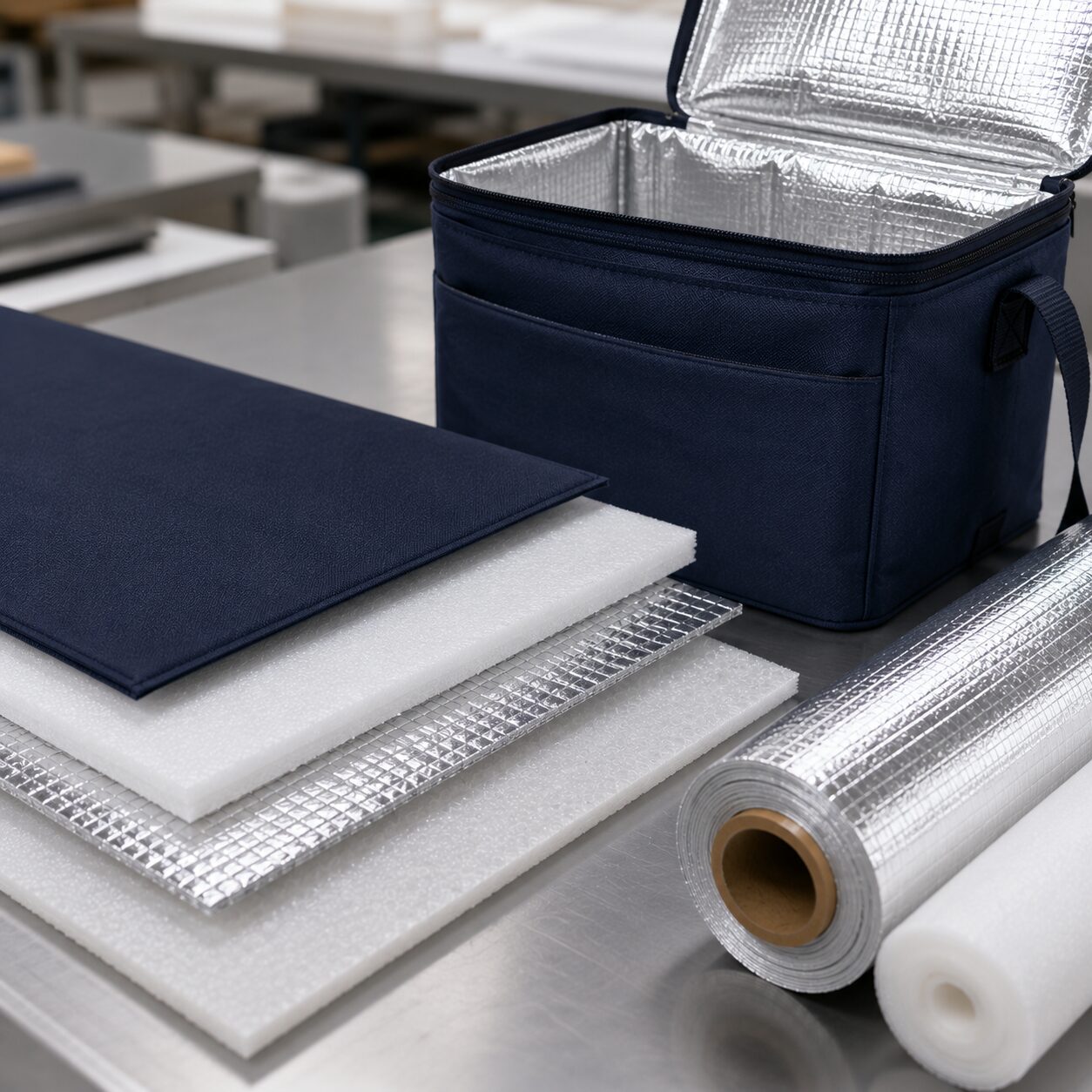
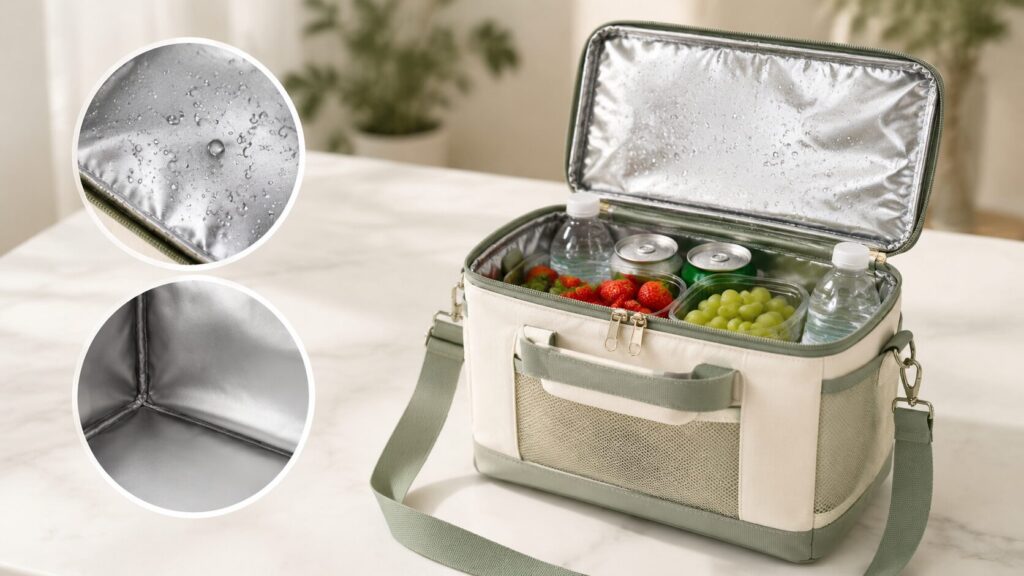
Material selection dictates structural integrity and thermal efficiency while dictating the overall cooler bag cost. Analyzing cooler bag material cost involves examining textiles, insulation, and waterproof linings. High-denier polyester and closed-cell foam require precise budgeting to ensure ice retention. Sourcing premium raw materials elevates retail value while maintaining sustainable budgets. Comparing 600D and 900D polyesters, EPE foam, and foil barriers highlights cost drivers. Outer shells need high tensile strength for abrasion resistance while thick EPE foam provides insulation. Foil layers reflect ambient heat away from chilled compartments. Selecting high-frequency welded PEVA versus TPU impacts overall cooler bag material cost significantly. Food-grade PEVA offers cost-effective waterproofing, while thermoplastic polyurethane delivers superior puncture resistance at higher price points.
- Shell Fabric Selection: Utilizing 600D or 900D polyesters provides high tensile strength to resist external abrasion and mechanical tearing.
- Insulation Density: Integrating thick closed-cell EPE foam and radiant foil barriers ensures optimal thermal decay performance.
- Lining Membrane Choice: Balancing food-grade PEVA against premium TPU linings optimizes waterproof reliability and unit expenses.
3. Labor and Assembly Overhead: Determining the Real Cooler Bag Manufacturing Cost
Labor hours and assembly overhead constitute major portions of baseline cooler bag manufacturing cost while shaping the final cooler bag cost. Multi-layer thermal chambers and seamless waterproof liners require specialized operators and high-frequency welding machines. Calculating true production expenses involves evaluating cutting efficiency, stitching time, and quality control. Optimizing workflows reduces labor bottlenecks and stabilizes unit production expenditures. Quantifying labor hours for insulated chambers clarifies complex overhead. Sewing thick insulation layers together demands heavy needle penetration and precise edge binding. Radio-frequency welding creates permanent waterproof bonds requiring skilled supervision. Evaluating how heavy-duty zippers, closures, and metal hardware alter baseline cooler bag manufacturing cost remains essential. Waterproof laminated zippers prevent thermal air leakage but add material costs. Metal pullers and custom D-rings require precise attachment sewing to withstand high tensile stress.
| Assembly Process | Labor Intensity | Technical Requirement |
| Multi-Layer Insulation Stitching | High | Heavy-duty needle penetration and edge binding |
| Radio-Frequency Welding | Moderate | Skilled technician supervision for seamless liners |
| Hardware & Zipper Integration | Moderate | Precision attachment sewing for high tensile stress |
4. Scaling Unit Economics: How Volume Shifts the Cooler Bag Unit Cost
Production volume dictates manufacturing amortization efficiency, lowering the cooler bag unit cost and optimizing the overarching cooler bag cost. Initial runs incur fixed setup expenses for custom printing plates, zipper molds, and cutting dies. Spreading fixed expenditures across thousands of units transforms expensive pilot runs into profitable inventory. Understanding volume-based pricing tiers enables accurate capital forecasting. Spreading setup fees across larger batches optimizes financial efficiency. Small pilot runs force factories to recover fixed tooling costs across few units, driving up sample prices. Scaling production volume dilutes fixed tooling expenses rapidly, reducing per-item financial burdens. Understanding how scaling drops your cooler bag unit cost transforms financial planning for e-commerce brands. Volume manufacturing unlocks wholesale material discounts and optimizes factory assembly line efficiency. Sourcing partners pass operational savings directly to buyers through structured pricing schedules.
- Tooling Amortization: Spreading fixed printing plates and cutting-die expenses across large batches reduces per-unit setup burdens.
- Material Tier Discounts: Higher production volumes unlock wholesale textile pricing that systematically lowers baseline expenses.
- Assembly Line Efficiency: Standardized mass production minimizes worker idle time and optimizes overall operational throughput.
5. Strategy for Brands: Navigating Custom Cooler Bag Pricing and Profit Goals
Establishing profitable retail margins requires managing landed factory expenses, freight, and fulfillment overhead while controlling cooler bag cost. Implementing a custom cooler bag pricing strategy for bespoke embroidery and private labels protects profitability. Brand directors must calculate total landed costs to ensure wholesale and direct-to-consumer models remain competitive. Strategic planning guarantees long-term viability. Landed costs include sea freight, customs clearance, and warehouse storage. Retailers markup baseline expenses to absorb commissions and customer acquisition costs. Analyzing how custom cooler bag pricing affects your bottom line requires evaluating embroidery and colorways. Pantone dyeing demands large minimum order quantities, while woven labels add incremental costs that elevate perceived retail value.
| Financial Component | Calculation Basis | Strategic Objective |
| Total Landed Cost | Factory FOB plus freight and duties | Establish true baseline financial exposure |
| Retail Markup Multiplier | Standard wholesale/D2C multiples | Absorb fulfillment and platform commissions |
| Customization Tiering | Incremental material and setup fees | Protect bottom-line profitability on bespoke SKUs |
6. Wholesale Dynamics: Calculating a Profitable Wholesale Cooler Bag Price
Setting competitive B2B wholesale thresholds drives global distribution while defining target cooler bag cost limits. Calculating a profitable wholesale cooler bag price requires balancing factory production with distributor commissions. Volume discounting incentivizes large recurring container orders. Transparent structures ensure stable distributor relationships. Manufacturers must price inventory to accommodate margins without inflating retail costs. Structuring a profitable wholesale cooler bag price tier maximizes volume through tiered price reductions for institutional purchase orders.
- Distributor Margin Accommodation: Pricing wholesale units to absorb regional partner warehousing and logistics markups safely.
- Tiered Volume Discounts: Structuring attractive price reductions for multi-thousand-unit institutional purchase orders.
- Factory Flow Stabilization: Leveraging large B2B distribution contracts to maintain steady assembly line production schedules.
7. From Cost Sheets to Bulk Containers: Transparent OEM Sourcing with Aimazing Bag
Eliminating middleman markups secures direct cost structures and optimizes total cooler bag cost. Partnering with Aimazing Bag ensures transparent operations and quality assurance. Direct collaboration protects investments via audits. Request our sourcing blueprint to optimize manufacturing budgets. Working directly guarantees material and labor visibility. Cost sheets prevent price hikes and protect margins. Pre-shipment audits ensure retail performance. Aimazing Bag scales production seamlessly.